In January 1945 a company of 120 American Rangers and Alamo Scouts sneaked across the Central Luzon plain and slipped behind enemy lines for 48 hours.
They attacked the Cabanatuan prison camp and liberated 511 American prisoners of war. The prisoners were survivors of the Bataan and Corregidor siege in 1942, and had been beaten and starved for 3 years.
Only 2 American Rangers died during the attack. A prisoner died of a heart attack during the rescue. Over 520 Japanese troops were killed or wounded during the raid.
Nothwithstanding the many Stallone and Chuck Norris iterations, the Cabanatuan raid remains the only real successful combat rescue of prisoners of war in American military history.
 I won’t detail this story. It was made into a movie. Every Filipino, and anyone interested in WWII in the Philippines, should see this film. The plot takes some literary liberties, but the essential storyline is faithful to history.
The cinematography (filmed in old Shanghai) of Manila during the Japanese occupation, the terrain (filmed in Queensland, Australia), the camp itself, are accurate beyond reasonable expectations.
Cabanatuan is in Central Luzon. Our backyard. It is on the eastern fringe of the plain, at the foothills of the Sierra Madre mountains.
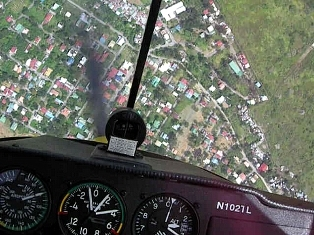
The site of the prison camp is now a memorial. You can still see the vague outlines of the camp, from the air.

There are 2 flagpoles, a memorial wall, a monument to the US 6th Ranger Battalion (in the photo surrounded by mats with drying rice), and a somewhat bizarre sundial.
Carlo and I flew over the camp several times during our tour.

During the raid in 1945, a P-61 Black Widow night fighter flew low over the camp at dusk, to distract Japanese guards.
At that moment, over 120 Rangers were crawling through light bush and grass right in front of the camp, towards the camp fence.
There was very little cover, hence the planned distraction.
 The Rangers crawled right up to the edge of the Cabanatuan-Cabu road, which passed in front of the camp.
They had to wait there until night fell, before beginning their attack.
Scene from the movie
Carlo and I were not in a twin-engined, radar-equipped night fighter, but we were in an airplane. We flew over the memorial, both of us imagining what it must have been like.

A mile east of the camp is an interesting place. A Filipino guerilla leader, Captain Juan Pajota, was tasked to hold the bridge at Cabu during the raid.
 Over 1,000 Japanese soldiers were across the Cabu river. If they rushed to reinforce the camp, they could easily overwhelm the 120-man US Ranger team there.
Juan Pajota and a small band of men held the bridge over the Cabu river. Not one Japanese soldier got across, despite several massed charges across the bridge. The guerillas even destroyed some Japanese tanks.
Pajota was a big success factor in the raid.
Today the bridge is a steel structure built in 1950, on the same site as the original wooden bridge.

It is easy to see how a small guerilla band could hold the bridge against a strong enemy force, including tanks.

There is no other way to get across the steep banks of the Cabu river.
Several accounts describe how Pajota waited for the flare that signaled the successful escape of the prisoners. He then looked with satisfaction on the battle scene at Cabu bridge, and smiled a rare smile.
In the movie, Filipino actor Cesar Montano plays the part of Juan Pajota. He remembers that smile with similar satisfaction. You can see that in the movie.
In 1976, the real Juan Pajota came to the U.S. to file for citizenship. A year later he was still waiting for citizenship. He died a few days before his case was resolved.
There are several books that document this amazing story. Ghost Soldiers by Hampton Sides, The Great Raid by William Breuer, and Hour of Redemption by Forrest Bryant Johnson. All of them have great photos, maps and diagrams.
As the credits scroll at the end of the movie, continue watching. Real footage taken by combat photographers portray the real POWs right after the raid, as well as the real characters.
 At the town of Balincarin, there is a memorial to Capt. James Fisher.
The surgeon for the raiders, Fisher was killed in the raid. When the Rangers passed through Balincarin the day before, Fisher dispensed medical care to the villagers.
The simple memorial is used today for drying rice.
The Great Raid. It really happened, in our backyard — Central Luzon.

POWs from Cabanatuan camp, just hours after the raid
.



 Flying in Crosswinds
While I was reading this blog, I could imagine the sacrifices of many people — Filipino and American rangers!
I hope many people would watch the movie and appreciate really the heroic exploits of the people who liberated the prisoners.
And remember the bitterness of war!
More power!
Al Jacinto
Editor
mindanaoexaminer.com
mindanaoexaminer.net
LikeLike
Wow, finally! I’ve been waiting for this post Tonet. Now I really gotta go and see that movie!
LikeLike
Hi Al and Suerte!
Thanks for dropping by. When I read the books about this raid, what struck me was how selfless and generous the Filipinos were towards the Americans.
There was the woman who insisted on giving an entire fried chicken cooked in banana leaf to a Ranger.
Every soldier had a place to sleep in the town of Platero, the night before the raid. Platero was only 2 kilometers from the prison camp, and every Filipino in the area was at risk for reprisals following the raid. And yet many gave up their beds to host the Rangers that night.
Pajota had about 200 men, more than the American Ranger team. He held a crucial roadblock at Cabu bridge, where over a thousand Japanese soldiers were encamped. He held that bridge until long after every American prisoner was safely across the Pampanga river, and only then did he withdraw. He suffered 23 casualties, and killed hundreds of enemy soldiers.
Pajota also had the idea of using carabao carts to evacuate non-ambulatory prisoners. His men scoured the area of Rizal, Balincarin, Platero and even Talavera, asking Filipinos to volunteer carts and carabaos. Over 20 carabao carts were assembled on the night of the raid, and over the next 12 hours that caravan grew to over 80 carts.
Filipinos came out in droves as the Americans escaped towards Guimba. They pressed food on their allies, promised to pray for them every night, and offered any sort of help.
It was also Pajota’s idea to use an American airplane to divert the Japanese guards in the crucial minutes before the attack, by having the airplane buzz low over the prison camp.
Two Filipino doctors at Platero — the Layugs, husband and wife — desperately tried to save the American combat surgeon, James Fisher. Fisher had bivouaced the night before in the Platero schoolhouse. He and the Layugs prepared the schoolhouse as an emergency surgery for the raid. They stocked blood plasma, laid out surgical instruments, prepared bandages and medical supplies.
The Layugs were devastated to learn that Fisher himself was critically wounded during the raid — the only American to fall from enemy fire (the only other casualty was another Ranger shot by a fellow American).
Fisher had insisted on joining the attack itself, instead of waiting at the surgical aid station in Platero. A Japanese soldier fired 3 mortar shells towards the main gate, as the rescue was winding down. Fisher was hit badly, his stomach, liver and kidneys lacerated by huge metal fragments.
He was evacuated to Platero, and there the Layugs desperately tried to save him, in his own emergency hospital. The Layugs wept when they realized they could do nothing.
In the morning, they desperately decided that Fisher’s only hope was to be flown out. Hundreds of Filipinos turned out to build an emergency airstrip, with hand tools, spoons and bare hands. By this time the Fisher had been moved to Balincarin.
Remember, all of this was taking place behind enemy lines. The nearest American army front line was at Guimba.
The airplane never came. Fisher died at Balincarin after losing almost all his blood.
The Filipino generosity and empathy were easy to understand. Over 2,656 American prisoners of war died at the Cabanatuan prison camp in the years before the rescue.
After the war, Fisher’s family hosted the Layugs in the United States, and offered to sponor them for advanced medical studies in the US.
Other trivia:
Laur, where Ninoy Aquino was incarcerated for many years, is only a few kilometers from the Cabanatuan prison camp.
Fort Magsaysay, the big Philippine Army training camp and air base, is less than 15 kilometers away.
A month ago I met Major Jess D. of the Philippine Army, who is a senior member of the Philippne Army skydiving team. His team did a jump during the commemoration of the anniversary of the Cabanatuan raid. Jess is now stationed in the Sudan, part of the Philippine contingent in the UN peacekeeping efforts there.
The US Embassy in the Philippines hosted the premiere of The Great Raid in one of the Ayala theaters in Makati. The producer of the film, Marty Katz, was there, along with Cesar Montano and his wife Sunshine, former President Fidel Ramos, Atty Bert Romulo, etc. Lots of pictures at
http://manila.usembassy.gov/wwwhr490.html
.
LikeLike
Hi Sir Tonet, I’m a fan of your blog. Very interesting story 🙂
Where can I find the site and how many nautical miles is it from Cabanatuan city?
LikeLike
Vinciboy, it is 6.5 kilometers (3nm) northeast of Cabanatuan City. CAB VOR is actually outside the city, so don’t get confused.
From Cabanatuan just follow the road northeast. The memorial is 6.5km, Cabu bridge 1km (0.5nm) more, then after that Bongabong, Laur, etc.
Stay out of Fort Magsaysay’s control zone. They will shoot you down.
Maintain 1,000 feet over populated areas 🙂
.
LikeLike
Hi Sir,
Thanks, I’ll try to check that place one of these days. Will maintain 1000′ 🙂
LikeLike
Hi to all,
Napakagandang pelikula, napanood ko ito several times sa Cinema One and I say talagang maganda. Magaling rin ang pagkakaganap ni Cesar Montano sa kanyang karakter.
Sana ay mapanood pa ito ng mas maraming Pilipino at ng mga taga-pamahalaan upang mabigyan ng pansin ang kasalukuyang sitwasyon ng mga naghihirap na beterano!
Mabuhay!
Al Jacinto
Mindanao Examiner
LikeLike
Sangayon ako diyan, Al. Sa mga dalaw ko sa kamaganak ko sa America, hinihila ko sila sa Blockbuster para hiramin ang DVD na The Great Raid. Dapat iyan mapanood ng lahat ng Pilipino.
LikeLike
Capt. Tonet sir!
I just saw The Great Raid a Couple of Days ago as part of a little project of mine rediscovering Manila before and during the war. I’ve got a whole bunch of movies here but this one brought tears to my eyes. Re-reading your article is watching the movie again. Galing!
I’m going to look for the old Nielsen field tower in Makati next, and maybe head out to find Provisor island in Pasig, and then maybe Intramuros afterwards.
Will furnish you a copy of Strategy & Tactics’ article on the Battle for Manila in 1945. It should interest you.
Wikipedia has articles on Capt. Pajota and some of the rangers involved in the raid. Fun reading, if you find yourself bored on an airliner with wifi.
cheers sir!
Mike B.
LikeLike
Mike B sir!
It was Komics (a former ‘inmate’ at the Philippine Military Academy) who said that “Every Filipino should see this movie.”
And he was right. For some reason, the movie is uplifting.
Maybe it’s the glimpse of scenes of Manila during the war years (actually shot on location in Shanghai).
Or the novelty of hearing Tagalog spoken liberally in a Hollywood production.
Maybe it’s the heartwarming depiction of the very real bond between Filipinos and Americans, and the mutual sacrifices both sides selflessly made for each other during the last ‘good’ war.
It might be the relief of remembering a time when American politics were less about self-evangelism and global ignorance and more truly about doing what they genuinely felt was right — liberating a country, freeing the POWs they had left behind 3 years ago, helping Filipinos overcome adversity.
The real Pajota (the guerilla leader played quite well in the movie by Cesar Montano, low-key without being subservient, triumphant without being arrogant) was entitled to US citizenship. But the bureaucracy took years. He went to the US to follow up, more than 20 years after the war, and died of cancer (I think) before his citizenship was granted.
One of the real-life Rangers participated also in the Son Tay raid in North Vietnam over 20 years later, which was a ‘dry hole’ (the prisoners had long been evacuated).
You will like the books — there are several, about the Raid — including Ghost Soldiers by Hampton Sides and The Great Raid on Cabanatuan by William Breuer.
Lots of pictures (they had combat photographers with them during the raid, and the stills used at the end of the movie during the credits are the actual pictures of the prisoners, the main characters and the terrain).
Here’s a link to a nice critique of the movie, worth reading.
Glad you liked the artice! Send me the one from Strategy and Tactics!
.
LikeLike
may memorial si fisher
wala kay Captain Juan Pajota!
ang liit talaga pagtingin natin sa ating mga sarili
LikeLike
Sangayon ako diyan.
Pero sino ang kikilos? At kailan?
Kung hindi tayo, sino pa?
King hindi ngayon, kailan pa?
Tayo mismo ang kumukunsinti sa panliliit natin sa ating sarili.
Salamat sa iyong pagdalo dito sa Flying in Crossiwnd, Rene.
.
LikeLike
I praise the Filipinos, both men and women who were a huge part of saving the men from the camp and it’s brutal keepers. While the men helped in the planning and execution of the raid, the women did their part, keeping medicines going to sick prisoners and distracting the Japanese soldiers as best they could. As far as citizenship in the US, I think strongly that Filipinos applying for US citizenship should be placed in a priority space, since their families have work with and saved many American lives during WWII. God Bless the Philippines! I am an Irish/Swedish US born Marine and proud to be married to a Pinay.
LikeLike
Hi Tim, thanks for visiting Flying in Crosswinds.
I’ve been following the current issue on US citizenship for Filipino veterans. While I understand the difficulty of substantiating all claims to veteran status, I do agree with you that a special effort should be made for Filipinos who fought alongside their American compatriots during the Japanese occupation.
After all, the U.S. didn’t leave the American prisoners behind. Three years late, maybe, but they were eventually rescued. It’s time to rescue some of the rescuers who are still alive.
Be sure to read the books, Ghost Soldiers by Sides and The Great Raid by Breuer. Fascinating story.
And I’m proud that you’re proud, Saddleback Mac!
.
LikeLike
Tonet,
I’m checking links from my blog and am thankful that your site is still up. And I’m more thankful that I saw one of your top post regarding “The Great Raid”.
I saw this one on DVD (orig pero sale) while randomly picking a buy 1 take 1 promo. I (with wifey) picked it up as the “take 1” just so to complete the purchase. But after watching it, I can now proudly stack it beside our other foreign war stories collection.
Not only was the movie great, but the story itself is indeed worthy to be tagged as the great raid. I’m convinced by the end of the movie that the Filipinos during the war are heroes then. It’s pity that nowadays, most are just cowards – sorry I can’t help but feel this way.
More power to you and Carlo. Keep on flying in crosswinds.
LikeLike
Hey Cris, thanks for your note. It was Kevin who first recommended the books on the Cabanatuan raid to me — The Great Raid, Ghost Soldiers, etc. (Kevin has never failed me on any reading recommendations.) The movie was ok, lots of fictional stuff, but essentially correct, and certainly stirring and inspiring, as you say.
Komics, a good friend who is a PMA veteran and who has done his bit for our country, once said that every Filipino should see this movie. I agree.
The documentary segments at the end were from the actual raid and the aftermath, taken by combat photographers who accompanied the raid.
Thanks for visiting again. We have some VERY good flying stories from the holiday season. We will certainly keep on flying in crosswinds, Cris.
Happy New Year!!
.
LikeLike
I thought you might be interested in the loss of an American hero: Prince, Robert W.
Robert W. Prince died after a long illness, at home with his family, on January 1, 2009, at age 89. He was born in Seattle, November 7, 1919. He graduated from Madrona grade school, Garfield High School in 1937, and Stanford University in 1941. He was married to Barbara Harrison of Seattle on January 31, 1941. Bob entered active service as a Lieutenant in the U.S. Army on July 7, 1941, and was discharged with the rank of Major in February 1946, from the 6th Ranger Infantry Battalion. He served in the Southwest Pacific in New Guinea, the Philippine Islands and in Japan. He was awarded the Distinguished Service Cross for his role in the rescue of 571 Bataan prisoners of war, from the Cabanatuan Prison Camp January 31, 1945. His business career involved the marketing of Washington apples in Seattle and Wenatchee for 40 years. He retired in 1985, from the presidency of Gwin, White and Prince Inc. He held several positions of leadership in the fruit Industry. He and his wife, Barbara, retired in Kirkland; after Barbara’s death in 2003, he moved to Port Townsend. He was a lifelong student of history, an avid follower of politics and until recently, an enthusiastic Husky football fan.
Bob was preceded in death by his son, Steve, killed in action in Vietnam in 1969; his beloved wife of 63 years, Barbara; and brothers, Ken and Dick of Seattle. He is survived by his brother, John of Seattle; son, Jim and his wife, Mardee Stadshaug of Port Townsend; and grandchildren, Amy Murray and Andrew Prince.
He will be lovingly remembered by his family and friends as a warm, generous, but reserved and humble man.
At Bob’s request, no Services will be held. Remembrances are suggested to the Children’s Orthopedic Hospital or a charity of your choice.
Published in the Wenatchee World from 1/7/2009 – 1/10/2009
LikeLike
Thanks for the information, Carl. I’m sure a lot of former prisoners of war from the Cabanatuan camp remain very thankful for Robert Prince’s planning and execution of the Raid. I’ll share this with friends who have read the books about the Cabanatuan Raid. And thanks for putting this on Flying in Crosswinds — as you can see from the comments here, at least some folks are not unaware of Prince’s and his comrades’ part in our country’s history.
Thank you for visiting Flying in Crosswinds, Carl!
.
LikeLike
Just finished watching “The Great Raid” last night and what those POWs went thru defies belief but it did happen. It has screened before but this time it was on very late hence the recording. The credits etc at the end is just as interesting as the film. Just read the bits on the www site. Anyway it is a story that should be and has been told to show the younger generation that war is not all about glory. My father was in the RNZAF in the Pacific and very rarely talked about it. He passed away in Sept 2008.
After watching “The Pacific”which screened recently in NZ one can now understand that these servicemen have great stories that need to be told.
LikeLike
The stories are disappearing too, since the veterans are getting fewer and fewer. The images during the credits are actual footage from the combat photographers who went along the raid, but who were unable to set up and film during the night assault itself.
Thanks for visiting Flying in Crosswinds, Grahame!
LikeLike
may mga video po ba ng behind the scenes or hpotos ng The Great Raid?
LikeLike
Hi Brian. The end-credits of the movie had actual video’s from the raid itself, taken by combat photographers attached to the Rangers.
I’m not sure about behind-the-scenes photos — you may want to look at IMDB’s website on the movie 🙂
LikeLike
The United States could not have found a better ally than the Philippines and the Philippines could not have provided a better warrior to help free U.S. prisoners than Juan Pajota. On behalf of my nation, I apoligize for a real wrong done a true friend. Considering the number of persons granted citizenship who have performed absolutely no service to this country, much less risked their lives to do it, Juan Pajota should have received citizenship the minute he applied for it. I am saddened he did not live to see that happen. May he rest in peace and the honor that he earned.
LikeLike
Tonet,
I recently finished the book, “Ghost Soldiers”, and found it to be very very uplifting. The bravery of the Filipinos and the Americans in rescueing the prisoners at Cabanatuan Prison was extraordinary. I have been to the Philippines twice, on mission trips, and plan to return in January 2012 with my wife. We are making arrangements to visit the Cabanatuan Prison Memorial site, Corregidor and hopefully the Cabu Bridge site. My father fought in the Philippines in WWII…and he always told me growing up that the Philippine people are the finest in the world. I plan to honor the men who died and escaped the prison by praying on the very sight of the prison. Captain Pajota and Colonel Mucci, LT Prince are to be highly esteemed for their planning and execution of the “great raid” along with all the support soldiers…Filipino and American.
God Bless you all,
Larry
LikeLike
Hi Larry, welcome to Flying in Crosswinds! Let me know if you want to FLY over the site also. You can see what the P-61 Black Widow night fighter airplane saw. Unfortunately there is no airport nearby, so I can’t drop you off 🙂
Thanks for your kind words about the Philippines, and the people. Stay in touch, please.
LikeLike
[…] Our backyard. With no pilotage chart or GPS, we can find Ben Hur’s chicken farm, or the prison camp from the Great Raid. […]
LikeLike
I lived near Cabanatuan in Bongabon for about 6 months, I married a Filipina woman who is now in the US with me…the site is great and the is kept in beautiful condition. Every WW2 memorial I saw during my time in the Philippines is kept in very clean. Very proud of the Philippines for this fact…I can’t wait until the wife and I can return….
LikeLike
Hope you make it back here soon! Thanks for you comment, and Merry Christmas!
LikeLike
I have many pictures from the Camp O’ Donnell Memorial in Cabanatuan…I can share them if anyone would like to see them…
LikeLike
Thanks, Woody! Did you visit the Cabanatuan Memorial?
LikeLike
Tonet….yes I visted the Cabanatuan Memorial, I travelled to the Philippines to get married to a beautiful Filipino girl and lived only a few miles from the Camp O’ Donnell memorial….awesome place….
LikeLike
Is there a way to post pics here?….I will share my pics if there is a way to post them here…
LikeLike
Hi Woody, unfortunately this is a blog, not a shared site. If you email your photos to me I will gladly post them for you as part of the comments on the article. tonetrivera@gmail.com
Or, if your photos are already on your personal or shared website, you can send the link to me and I will post the link as part of the article.
Thanks!
LikeLike
I have the pics on my WW2 History page I run that is on Facebook, I can send them to your email. If you do put my pics on this blog will I be credited?…
LikeLike
Of course! Find me on FB and I will download and credit 🙂
Sent from my BlackBerry 10 smartphone.
LikeLike
Here is the link to the photo album of my photos of the Philippine/American POW Camp in Cabanatuan…use what you like, and all pics are captioned by me…
https://www.facebook.com/media/set/?set=a.10150354499549382.371346.359212319381&type=3
LikeLike
Another movie that showed the raid briefly was called “Back To Bataan” with John Wayne. It also had actual film of the raid survivors. There were many Filipino actors in that movie also, good stuff.
LikeLike
The raid at Los Banos is another POW rescue that was carried out by US and Filipino militia members. The airborne soldiers were dropped right outside the POW Camp fence, and everyone was rescued with NOT ONE casualty. The audacity and the overwhelming force that was brought to bear against the Japanese captors made it as successfull as the Cabanatuan raid…both POW rescues are still taught in US military acadamies..
LikeLiked by 1 person